What's in Cebu....
What is Filipino Food?
The Philippines country culture starts in a tropical climate divided into rainy and dry seasons and an archipelago with 7,000 islands.These isles contain the Cordillera mountains; Luzon’s central plains; Palawan’s coral reefs; seas touching the world’s longest discontinuous coastline; and a multitude of lakes, rivers, springs, and brooks.
The population—120 different ethnic groups and the mainstream communities of Tagalog/Ilocano/Pampango/Pangasinan and Visayan lowlanders—worked within a gentle but lush environment. In it they shaped their own lifeways: building houses, weaving cloth, telling and writing stories, ornamenting and decorating, preparing food.
The Chinese who came to trade sometimes stayed on. Perhaps they cooked the noodles of home; certainly they used local condiments; surely they taught their Filipino wives their dishes, and thus Filipino-Chinese food came to be. The names identify them: pansit (Hokkien for something quickly cooked) are noodles; lumpia are vegetables rolled in edible wrappers; siopao are steamed, filled buns; siomai are dumplings.
All, of course, came to be indigenized—Filipinized by the ingredients and by local tastes. Today, for example, Pansit Malabon has oysters and squid, since Malabon is a fishing center; and Pansit Marilao is sprinkled with rice crisps, because the town is within the Luzon rice bowl.
When restaurants were established in the 19th century, Chinese food became a staple of the pansiterias, with the food given Spanish names for the ease of the clientele: this comida China (Chinese food) includes arroz caldo (rice and chicken gruel); and morisqueta tostada (fried rice).
When the Spaniards came, the food influences they brought were from both Spain and Mexico, as it was through the vice-royalty of Mexico that the Philippines were governed. This meant the production of food for an elite, nonfood-producing class, and a food for which many ingredients were not locally available.
Fil-Hispanic food had new flavors and ingredients—olive oil, paprika, saffron, ham, cheese, cured sausages—and new names. Paella, the dish cooked in the fields by Spanish workers, came to be a festive dish combining pork, chicken, seafood, ham, sausages and vegetables, a luxurious mix of the local and the foreign. Relleno, the process of stuffing festive capons and turkeys for Christmas, was applied to chickens, and even to bangus, the silvery milkfish. Christmas, a new feast for Filipinos that coincided with the rice harvest, came to feature not only the myriad native rice cakes, but also ensaymadas (brioche-like cakes buttered, sugared and cheese-sprinkled) to dip in hot thick chocolate, and the apples, oranges, chestnuts and walnuts of European Christmases. Even the Mexican corn tamal turned Filipino, becoming rice-based tamales wrapped in banana leaves. The Americans introduced to the Philippine cuisine the ways of convenience: pressure-cooking, freezing, pre-cooking, sandwiches and salads; hamburgers, fried chicken and steaks.
Add to the above other cuisines found in the country along with other global influences: French, Italian, Middle Eastern, Japanese, Thai, Vietnamese. They grow familiar, but remain “imported” and not yet indigenized.
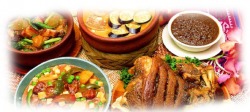
On a buffet table today one might find, for example, kinilaw na tanguingue, mackerel dressed with vinegar, ginger, onions, hot peppers, perhaps coconut milk; also grilled tiger shrimp, and maybe sinigang na baboy, pork and vegetables in a broth soured with tamarind, all from the native repertoire. Alongside there would almost certainly be pansit, noodles once Chinese, now Filipino, still in a sweet-sour sauce. Spanish festive fare like morcon (beef rolls), embutido (pork rolls), fish escabeche and stuffed chicken or turkey might be there too. The centerpiece would probably be lechon, spit-roasted pig, which may be Chinese or Polynesian in influence, but bears a Spanish name, and may therefore derive from cochinillo asado. Vegetable dishes could include an American salad and a pinakbet (vegetables and shrimp paste). The dessert table would surely be richly Spanish: leche flan (caramel custard), natilla, yemas, dulces de naranja, membrillo, torta del rey, etc., but also include local fruits in syrup (coconut, santol, guavas) and American cakes and pies. The global village may be reflected in shawarma and pasta. The buffet table and Filipino food today is thus a gastronomic telling of Philippine history.
What really is Philippine food, then? Indigenous food from land and sea, field and forest. Also and of course: dishes and culinary procedures from China, Spain, Mexico, and the United States, and more recently from further abroad.
What makes them Philippine? The history and society that introduced and adapted them; the people who turned them to their tastes and accepted them into their homes and restaurants, and especially the harmonizing culture that combined them into contemporary Filipino fare.
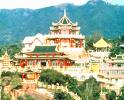
Visit places like Kawasan Falls, Tops, Beverly Hills Chinese temple, Regency Building, Island in the Sky in Balamban etc......
Cebu Is Famous For...
Guitars
Guitar-making is the occupation of the people of Mactan District and Maribago District in Lapulapu City.
Mangoes
Tropical island Cebu is famous not only for its fresh mangoes but its export-quality dried mangoes.
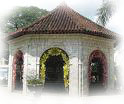
Magellan’s Cross
Planted in April 21, 1521 by Ferdinand Magellan, it is the spot where the first Christian Filipinos, Rajah Humabon and Queen Juana and about 400 of their followers, were baptized by Fr. Pedro Valderema.
Image of Santo Niño
Considered as the oldest religious relic in the Philippines, the image of the Santo Niño, or Holy Child, was given by Ferdinand Magellan to Queen Juana, among the first Filipinos to be Christianized, as a baptismal gift in 1521. The image survived a great fire in 1565 unscratched. It has since been deemed miraculous and venerated by the Cebuanos as their patron saint.
Basilica Minor del Santo Niño
The church was built by Miguel Lopez de Legaspi and Father Andres Urdaneta on the site where the image of Santo Niño was found in 1565. The first structure of the church was, however, destroyed by fire on November 1, 1568. It was rebuilt in 1602 under the administration of Juan Albaran and was rehabilitated in 1740. On May 1965, the church was conferred the title of Basilica Minor del Santo Niño by Cardinal Antonuitte, Papal Legate during the Fourth Centennial Celebration of the Christianization of Cebu.
Sinulog Festival
Cebu’s biggest and most popular festival, the Sinulog Festival is a feast in honor of the Holy Image of Senyor Santo Niño de Cebu. People converge along the routes of a grand solemn procession and partake in the gaiety amidst a mardi gras parade immersed in wild colors and the constant beating of drums. Fiesta Senyor, as it is widely known, is celebrated every third Sunday of January.
Mactan Island
It is a coral island and famous scuba diving and beach site. It is also the site of the Export Processing Zone, which presently employs a 37,118-strong workforce. Mactan Island, located across Mandaue City, encompasses a total land area of 150 hectares.
Malapascua Island
Malapascua, a term that literally means "Unfortunate Christmas," is a paradise where time stands still. The island is blessed with white sand beaches and crystal clear waters. The west coast is especially ideal for swimming and snorkeling. It takes about three hours by land from Cebu City to reach the island, which lies at the northern tip of Cebu and west of Leyte.
Moalboal
About a third of the way up the west coast of Cebu is the sleepy little market town of Moalboal. About five kilometers outside the town, down a dusty track, is Panagsama Beach, which was one of the first places where scuba diving caught on in the Philippines. In the early 1980s, it was one of the most popular and highly regarded diving destinations in Asia, which led to dive resorts having sprung up all along the adjacent coast. From Moalboal, you can dive straight off Panagsama Beach. All you need to do is swim out a few meters and drop down onto a beautiful, sloping wall that descends to 35 meters. Panagsama Beach is home to an extraordinary array of coral, anemones, sponges, and a swarming host of brightly colored reef fish.
Olango Wildlife Sanctuary
Olango Island supports the largest concentration of migratory birds found thus far in the country. Migration of these birds starts from their breeding places in Siberia, Northern China, and Japan. Based on data gathered so far, the birds use Olango as a major refueling station as well as a wintering ground. At Olango, the birds can replenish their fat reserves by feeding on the rich supplies of invertebrates in the intertidal mudflats. These fat reserves fuel the birds on the next lap of their journey, which may cover from 3,000 to 15,000 kilometers of nonstop flight.
Please visit the links for more travel tips:
http://wikitravel.org/en/Cebu_%28city%29http://www.lonelyplanet.com/philippines/the-visayas/cebu-cityhttp://www.wowphilippines.com.ph/